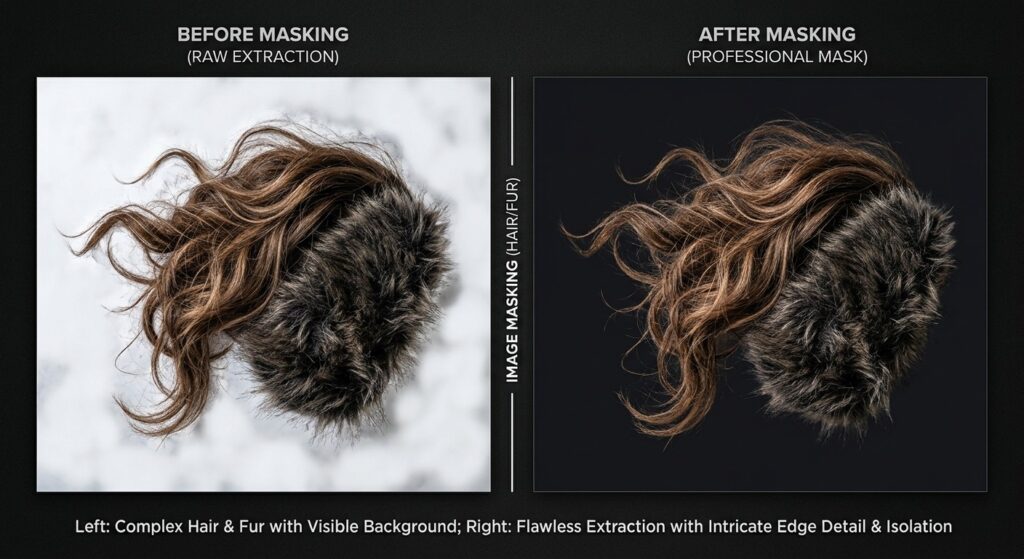
A beautiful photograph is only the starting point of a polished and visually appealing result. The real challenge often begins during post-production, especially when photographs contain complicated details such as human hair, animal fur, feathers, and other fine textures. These elements are difficult to separate from their original backgrounds because of their delicate edges, individual strands, and irregular shapes. Traditional selection techniques may remove important details, resulting in unnatural edges and poor-quality images.
This is where professional image masking for hair and fur becomes essential. Image masking is an advanced photo editing technique that allows editors to separate complex subjects from their backgrounds while preserving fine details, natural textures, and realistic edges. It is particularly valuable for photographers, e-commerce businesses, advertising agencies, fashion brands, pet photography studios, and digital marketing professionals.
Whether you are editing a portrait with flowing hair or a photograph of an animal with thick, textured fur, professional image masking helps maintain the original appearance of the subject while making background replacement and other creative adjustments possible.
In this comprehensive guide, we will explore how image masking works, why it is important for hair and fur photography, the techniques involved, common challenges, and how businesses can benefit from professional image masking solutions.
What Is Image Masking in Photo Editing?
Image masking is a non-destructive photo editing technique used to hide or reveal specific areas of an image without permanently deleting the original pixels. Unlike basic selection methods, masking provides greater control over complex edges, transparent objects, and fine details.
Professional editors commonly use layer masks in Adobe Photoshop to isolate subjects from their backgrounds. By working with black, white, and different shades of gray, editors can control which parts of an image remain visible.
• White reveals the selected image areas.
• Black hides unwanted image areas.
• Gray creates partial transparency and smooth transitions.
This technique is especially useful for photographs containing complicated textures that cannot be accurately selected using ordinary clipping paths.
For example, removing the background from a portrait with long, curly hair requires careful attention to individual strands. A simple selection might cut off the hair edges or leave unwanted background colors around them. Image masking provides the flexibility needed to preserve these delicate details.
Why Professional Image Masking for Hair and Fur Is Important
Hair and fur are among the most challenging elements in professional photo editing. Unlike solid objects with clearly defined boundaries, these subjects contain thousands of fine details that blend naturally into their surroundings.
A professional masking process helps preserve these details while producing clean, realistic, and visually appealing results.
Preserving Individual Hair Strands
Human hair can contain straight, curly, wavy, fine, or thick strands. When photographed against a complicated background, individual strands may become difficult to distinguish.
Professional image masking helps editors retain these details without making the edges look artificially sharp.
Important benefits include:
• Preserving loose and flyaway hair strands.
• Maintaining natural hair volume and texture.
• Avoiding rough or jagged selection edges.
• Creating realistic transitions between the subject and background.
• Supporting natural-looking background replacement.
This is particularly important for fashion photography, beauty campaigns, professional portraits, and commercial advertising.
Maintaining Natural Fur Texture
Animal fur presents a different set of editing challenges. Depending on the animal, fur may be short, long, thick, curly, fluffy, or layered.
A poor selection can remove fine fur details, making the animal appear artificial or unnaturally smooth.
Professional masking helps maintain:
• Individual fur strands.
• Natural fur density and volume.
• Soft and irregular outer edges.
• Fine details around ears, tails, and paws.
• Realistic separation between the subject and its background.
These improvements are essential for pet photography, wildlife images, animal product advertisements, and creative commercial projects.
Common Challenges When Masking Hair and Fur
Even experienced photo editors can face difficulties when working with complex hair and fur images. Understanding these challenges helps explain why professional masking requires patience, technical knowledge, and attention to detail.
Fine and Flyaway Hair
Loose hair strands are often almost transparent or extremely thin. They may overlap with the background, making them difficult to identify.
If an editor uses an aggressive selection technique, these strands can disappear completely.
Similar Background and Subject Colors
When hair or fur has a color similar to the original background, separating the subject becomes more complicated.
For example, blonde hair against a light-colored wall or white animal fur against a snowy background can create difficult editing situations.
Complex Fur Patterns
Animals with mixed colors, spots, stripes, and irregular textures require detailed selections. A single masking technique may not produce satisfactory results across the entire subject.
Background Color Contamination
Photographs sometimes contain unwanted background colors reflected along the edges of hair or fur.
This problem is commonly known as color spill or edge contamination. It becomes particularly noticeable after placing the subject against a new background.
Transparent and Semi-Transparent Details
Some hair strands allow background colors to show through naturally. Preserving these subtle transitions is important for realistic results.
Professional editors must balance transparency, edge softness, and subject visibility to avoid unnatural cutouts.
Professional Techniques Used for Hair and Fur Masking
Achieving excellent masking results requires more than simply selecting a subject and removing its background. Professional editors combine several techniques depending on the image quality, texture, lighting, and complexity.
1. Select and Mask Technique
Adobe Photoshop offers a Select and Mask workspace designed to refine complicated selections.
Editors can use this feature to improve subject boundaries, detect fine hair details, and adjust edge transitions.
Useful controls include:
• Radius adjustment for detecting complex edges.
• Smart Radius for adapting to different edge types.
• Refine Edge Brush for improving hair and fur selections.
• Feather for creating smoother transitions.
• Contrast for strengthening selected boundaries.
• Shift Edge for adjusting the selection outline.
These controls help editors produce more accurate selections while minimizing unwanted background areas.
2. Layer Masking
Layer masking is one of the most important techniques in professional image editing.
Instead of permanently erasing unwanted areas, editors use masks to control visibility. This makes it possible to modify the selection whenever necessary.
For hair and fur images, layer masks provide several advantages:
• Non-destructive editing.
• Greater control over fine details.
• Easy correction of mistakes.
• Flexible background replacement.
• Better blending between different image layers.
3. Refine Edge Brush Technique
The Refine Edge Brush is particularly useful for separating fine hair strands and textured fur from complicated backgrounds.
Editors carefully brush along the subject’s edges so that Photoshop can better distinguish foreground details from surrounding background pixels.
This technique can improve:
• Curly and wavy hairstyles.
• Fine individual hair strands.
• Fluffy animal fur.
• Feathered edges.
• Irregular natural textures.
However, the result still requires manual inspection because automated edge detection may struggle with complicated lighting or similar colors.
4. Channel Masking
Channel masking is an advanced technique that uses image contrast to create precise selections.
Individual color channels may contain stronger contrast between the subject and background. Editors can examine the red, green, and blue channels to identify which one provides the clearest separation.
This technique can be especially helpful when working with:
• Light-colored hair against dark backgrounds.
• Dark fur against bright backgrounds.
• High-contrast portrait photography.
• Complex animal textures.
Channel masking requires experience because every image has different lighting and contrast characteristics.
5. Manual Mask Refinement
Automated selection tools are useful, but they cannot always understand the natural appearance of every hair strand or fur pattern.
Manual refinement allows editors to correct problem areas and improve the overall result.
Professional editors may use soft brushes, custom selections, and carefully adjusted mask properties to restore missing details and remove unwanted edges.
The goal is not simply to create a clean cutout. It is to make the final photograph look natural.
Image Masking vs. Clipping Path: Understanding the Difference
Both image masking and clipping path techniques are used to isolate subjects from backgrounds, but they are suitable for different types of images.
Clipping paths generally use vector paths to create precise boundaries around objects with clearly defined edges.
Image masking uses pixel-based selections and transparency controls to handle more complicated subjects.
Here are the main differences:
Clipping Path:
• Best for products with solid and clearly defined edges.
• Commonly used for furniture, shoes, bags, and electronic products.
• Provides precise geometric selections.
• Works well when the subject has a clearly visible outline.
Image Masking:
• Best for hair, fur, feathers, and complicated textures.
• Preserves fine details and soft edges.
• Supports partial transparency.
• Allows more flexible background separation.
For example, a handbag with a solid outline may require a clipping path, while a portrait with flowing hair will generally benefit from image masking.
Choosing the right technique depends on the subject and the desired final appearance.
Industries That Benefit from Professional Hair and Fur Masking
Professional image masking is valuable across several industries where attractive and realistic photographs influence customer engagement and purchasing decisions.
Fashion and Beauty Industry
Fashion brands frequently use photographs containing flowing hair, detailed hairstyles, and creative backgrounds.
Professional masking allows designers and photographers to replace backgrounds, create promotional visuals, and maintain consistent branding.
Common applications include:
• Fashion magazine photography.
• Beauty product advertisements.
• Haircare promotional campaigns.
• Model portfolio editing.
• Social media marketing visuals.
Pet Photography and Animal Businesses
Pet photography studios often work with animals that have complicated fur patterns and fluffy textures.
Professional masking makes it easier to create attractive portraits with customized backgrounds.
It is useful for:
• Pet portraits.
• Animal adoption campaigns.
• Veterinary promotional materials.
• Pet product advertisements.
• Personalized animal artwork.
E-commerce and Online Retail
Online retailers depend on high-quality images to present their products professionally.
Although many e-commerce products have solid edges, certain products contain hair-like textures, feathers, fur, or fabric fibers that require masking.
Examples include:
• Fur clothing and accessories.
• Plush toys.
• Feather-based decorative products.
• Animal-related merchandise.
• Textured fashion products.
Accurate masking helps maintain product details while supporting consistent visual presentation.
Advertising and Digital Marketing
Advertising agencies regularly create promotional graphics that combine multiple visual elements.
Hair and fur masking makes it easier to isolate subjects and place them into creative environments.
This technique supports:
• Digital advertising campaigns.
• Website banners.
• Promotional posters.
• Social media graphics.
• Creative photo compositions.
How Professional Image Masking Improves E-commerce Photography
Product photography is an important part of online shopping. Customers cannot physically examine products before purchasing, so images must communicate important visual details.
Professional masking can help businesses create cleaner, more consistent, and more attractive product presentations.
Some major advantages include:
Better Visual Presentation
Cleanly separated subjects look more professional and allow customers to focus on the product or main subject.
Consistent Backgrounds
Businesses can maintain similar background styles across product catalogs, promotional campaigns, and online marketplaces.
Greater Creative Flexibility
Masked images can be placed against different backgrounds without photographing the subject again.
Improved Marketing Materials
Businesses can reuse properly masked photographs for websites, advertisements, banners, and social media content.
Better Image Quality
Careful masking preserves fine details that might otherwise disappear during basic background removal.
For businesses that regularly process large image collections, outsourcing professional masking can also help maintain consistent editing quality.
Why Manual Attention Matters in Professional Image Masking
Modern photo editing software includes several automated tools that can identify subjects and remove backgrounds. However, automation does not guarantee perfect results.
Complex hair and fur often require additional human attention.
Professional editors understand how to evaluate:
• The direction and movement of hair strands.
• Natural fur patterns and density.
• Light and shadow around the subject.
• Background color reflections.
• Edge transparency.
• Fine details that automated selections may overlook.
Combining software tools with manual refinement produces more reliable results than depending entirely on automatic selections.
This is particularly important for commercial photographs where unrealistic edges can reduce the overall quality of a campaign.
How to Choose the Right Image Masking Service Provider
Choosing a reliable image editing company is important when image quality, consistency, and delivery time matter to your business.
Before selecting a provider, consider the following factors.
Review the Company’s Portfolio
Examine previous examples of hair and fur masking. Look for natural edges, preserved fine details, and clean background separation.
Check Editing Quality
A professional provider should be able to handle different types of images, including complicated portraits, animal photography, and textured products.
Ask About Manual Editing
Find out whether the company provides manual refinement when automated selections are insufficient.
Consider Bulk Image Processing
If your business regularly needs hundreds or thousands of edited images, choose a provider capable of handling larger projects consistently.
Evaluate Communication and Delivery
Clear communication, reliable turnaround times, and consistent output are important for long-term business relationships.
Compare Pricing and Value
The cheapest service is not always the best option. Evaluate the quality of the finished images alongside pricing and delivery commitments.
For businesses seeking reliable solutions, exploring professional image masking services can help identify the right editing approach for different photography requirements.
You can learn more about specialized solutions through professional image masking services offered by Clipping Partner India. Selecting an appropriate masking technique helps businesses maintain fine details, improve background separation, and create visually appealing photographs for different commercial applications.
Common Mistakes to Avoid When Masking Hair and Fur
Even small mistakes can make a masked photograph look artificial. Professional editors should pay attention to the following issues.
• Over-sharpening edges: Extremely sharp boundaries can make hair and fur look unnatural.
• Removing fine strands: Aggressive selections may eliminate important details.
• Leaving background halos: Unwanted colored outlines can remain around the subject.
• Using excessive feathering: Too much feathering can make the subject look blurry.
• Ignoring color contamination: Original background colors may remain visible along the edges.
• Creating inconsistent transparency: Poor mask adjustments can make fine hair strands look disconnected.
• Overusing automatic tools: Automated selections may overlook complicated details.
Avoiding these mistakes helps maintain a realistic appearance and improves the overall quality of the final image.
The Future of Professional Image Masking
Photo editing technology continues to evolve. Artificial intelligence, automated background removal, and advanced selection tools are making image editing faster and more accessible.
However, professional masking remains important because complicated textures still require careful evaluation and refinement.
Future developments are likely to improve:
• Automatic hair and fur detection.
• Fine-edge transparency recognition.
• Background color correction.
• High-resolution image processing.
• Batch image editing workflows.
• Integration between AI-assisted selections and manual refinement.
These improvements may reduce editing time, but professional quality control will continue to play an important role in producing realistic commercial images.
Conclusion: Create Natural and Professional Images with Expert Masking
Hair and fur are among the most challenging subjects to edit because of their delicate textures, irregular boundaries, and fine details. Basic selection methods may remove important strands, create rough edges, or leave unwanted background colors.
Professional image masking for hair and fur provides a more effective solution by allowing editors to preserve natural textures while separating subjects from their original backgrounds.
From fashion photography and beauty campaigns to pet portraits, e-commerce catalogs, and digital advertising, accurate masking helps create visually appealing images that maintain their original character.
By combining advanced Photoshop techniques, layer masks, channel masking, and manual refinement, professional editors can achieve clean and realistic results.
For businesses, photographers, and creative professionals, investing in quality image masking is an effective way to improve visual presentation, maintain consistent branding, and produce professional photographs for multiple marketing platforms.
When every fine detail matters, professional image masking makes the difference between an ordinary cutout and a natural-looking photograph.